 GenshinZone
As 2026 unfolds and Genshin Impact continues to dominate the live-service landscape, longtime players still recall the seismic shift sparked by the Version 2.0 update, titled "The Immovable God and the Eternal Euthymia." Launched on July 21, 2021, this expansion introduced the Inazuma region – an island nation ruled by the Electro Archon – and marked a turning point that solidified miHoYo's free-to-play, anime-styled juggernaut as an enduring global phenomenon.
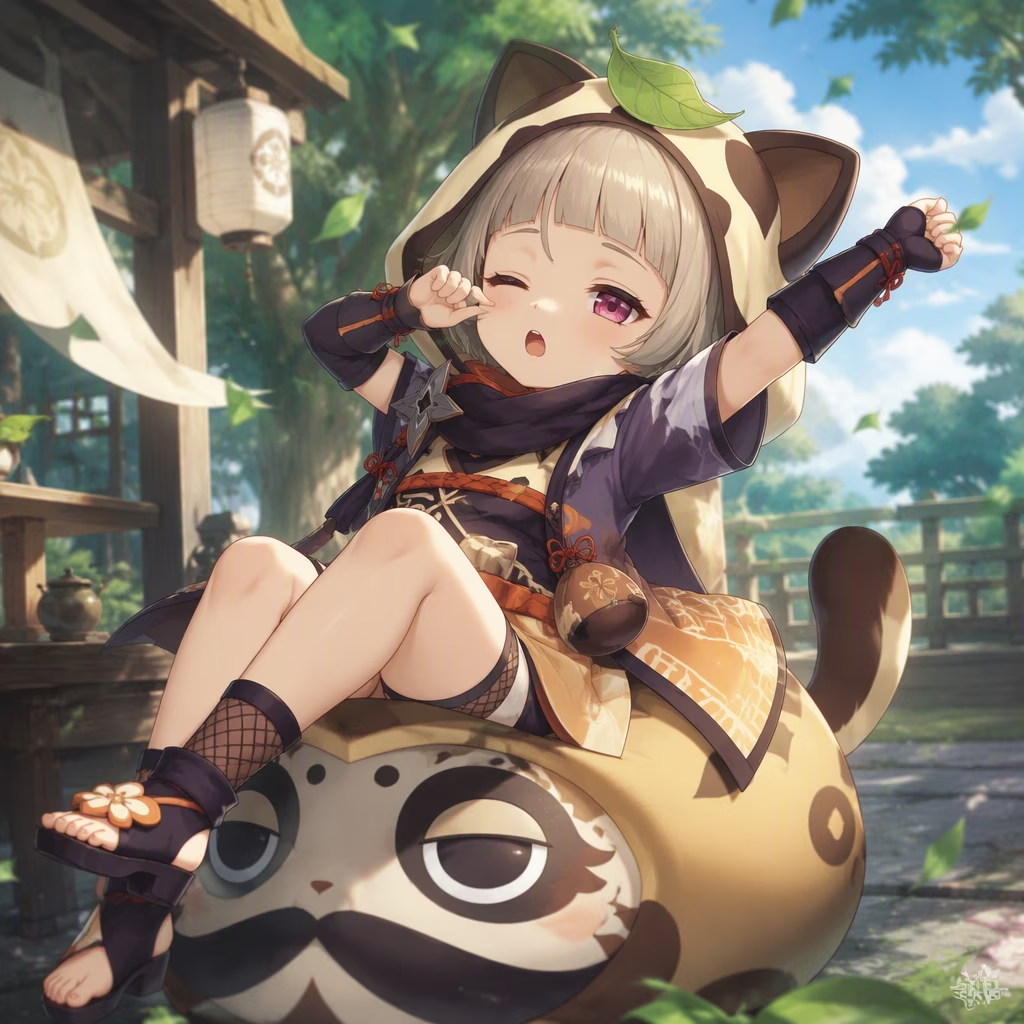
The Inazuma archipelago, separated from the already released regions of Mondstadt and Liyue by a vast sea, brought an entirely new cultural identity to Teyvat. Its six main islands – Narukami, Kannazuka, Yashiori, Watatsumi, Seirai, and Tsurumi – each offered distinct biomes, from serene shrines and blooming sakura trees to storm-wracked cliffs and tatarigami-infested villages. The press materials of that time emphasized that the locations within Inazuma housed completely different cultures, creatures, and mysteries, a promise that the development team delivered on through intricate questlines and environmental storytelling. Visual inspirations drawn from feudal Japan infused every corner, from the architectural elegance of Inazuma City to the melancholic beauty of Chinju Forest.
The narrative backbone of this chapter revolved around the Raiden Shogun, the Electro Archon, who had grown obsessed with the pursuit of eternity. Her decree, the Vision Hunt Ceremony, stripped citizens of their ambitions, creating a tense atmosphere that players had to navigate. This stark philosophical conflict gave the story a darker, more introspective tone compared to the relatively hopeful arcs of earlier regions. Key characters introduced in this era, such as the five-star Cryo swordswoman Kamisato Ayaka, the cunning pyro-user Yoimiya, and the oni-blooded Arataki Itto (who arrived shortly after in subsequent patches), became immediate fan favorites and remain staples in many party compositions even in 2026. Their unique playstyles were essential for tackling the formidable new enemies and world bosses added to the game, including the Maguu Kenki, the Pyro Hypostasis, and the weekly boss La Signora.
Beyond the narrative and character additions, Version 2.0 delivered a feature that arguably had the most significant long-term impact on Genshin Impactʼs accessibility: full cross-save functionality. For the first time, the game allowed seamless progression transfer across PC, PlayStation consoles, and mobile devices. This was a game-changer for a title that already boasted a massive multi-platform player base. Players could now explore Inazuma on their PC at home, complete daily commissions on their mobile phone during a commute, and dive into co-op domains on a PlayStation 5 from the couch – all while retaining their adventure rank, characters, and inventory. The convenience of this feature strengthened the community bonds and daily engagement metrics, setting a standard that many live-service games have since sought to emulate.
The update also brought enhanced experiences tailored to specific platforms. PlayStation 5 players benefited from DualSense wireless controller haptic feedback support, which made bow aiming, gliding, and elemental bursts feel more visceral. Meanwhile, all versions received improved character shading, more granular graphics settings, and performance optimizations that smoothed out the experience on lower-end mobile hardware. The visual upgrade was particularly striking when contrasted with the game's launch state – Inazuma's dynamic weather effects, such as Balethunder and the cleansing rain of the Sacred Sakura, showcased the engine's growing maturity.
At the time of the 2.0 launch, many fans were still anticipating the Nintendo Switch version that miHoYo had originally announced. In 2021, that port had been delayed indefinitely, and the silence surrounding its development became a long-running meme within the community. Fast forward to 2026, and while Genshin Impact eventually arrived on "Nintendo's next-generation platform" (as the company pivoted away from the aging Switch hardware), the Inazuma era is fondly remembered as the moment when the gameʼs potential truly crystallized. It expanded the world not just geographically but also thematically, proving that miHoYo could sustain and evolve its ambitious open-world experience.
Today, with the game having expanded into Snezhnaya and beyond, the impact of Version 2.0 remains unmistakable. The Inazuma soundtrack, composed by Yu-Peng Chen and HOYO-MiX, still ranks among the most celebrated video game scores, and its characters consistently top anniversary polls. Financial analysts frequently point to the period following the Inazuma update as the inflection point that sent Genshin Impactʼs revenue into the stratosphere, surpassing multiple established AAA franchises. The updateʼs success validated the aggressive six-week update cadence and reassured investors that HoYoverse (formerly miHoYo) was not a one-hit wonder.
For veterans logging in daily in 2026, completing their Battle Pass and tackling the latest Spiral Abyss rotations, memories of first setting foot on Ritou island in 2021 still evoke a sense of wonder. Version 2.0 didn't just add a map expansion; it redefined what a free-to-play game could accomplish narratively and technically. As the game continues its journey toward the final chapter of Teyvat, the Electro Archonʼs eternity will forever stand as a beacon of that transformative summer when a promise of "cross-save" and an island nation changed everything.